The Data Center Ecosystem: A Beginner's Guide to the Digital World's Engine
Every cloud service, streaming video, and AI application runs on physical infrastructure somewhere. Here is a ground-up explanation of what a data center is, who runs them, and why operations excellence matters.
Behind every email you send, every video you stream, every AI chatbot you use, there is a data center. A physical building full of servers, cooling systems, power infrastructure, and the human beings who keep it all running.
Most people who work in technology have a vague sense of what a data center is. Far fewer understand the ecosystem of companies, roles, and infrastructure that makes them function. This post aims to fix that.
What Is a Data Center?
A data center is a facility that houses computing infrastructure (servers, storage systems, networking equipment) along with the power and cooling systems needed to keep them running continuously.
The core promise of a data center is uptime: the equipment inside needs to work 24/7/365, year after year. A single hour of downtime for a major cloud provider can cost millions of dollars and affect millions of users.
This is why data centers are engineered with extraordinary redundancy. Power comes from multiple utility feeds, backed by generators, backed by UPS systems. Cooling has N+1 or N+2 redundancy. Network connectivity has multiple diverse paths.
Who Runs Data Centers?
The ecosystem has several distinct categories:
Hyperscalers
The largest data center operators in the world (Amazon/AWS, Microsoft/Azure, Google/GCP, and Meta) each operate tens of millions of servers in hundreds of facilities globally. They build, own, and operate their own infrastructure at a scale that is difficult to comprehend.
Colocation Providers
Companies like Equinix, Digital Realty, and CyrusOne build large facilities and rent space, by the rack, cage, or suite, to customers who want to house their own equipment. The colo operator handles the facility (power, cooling, physical security); the customer manages their own servers.
Managed Service Providers
MSPs operate data centers and also manage the servers inside them on behalf of customers. They sit between a pure colo and a full cloud provider.
Enterprise Data Centers
Many large organizations (banks, hospitals, government agencies) operate their own private data centers. These are often older, on-premises facilities that house legacy systems alongside more modern infrastructure.
The Physical Infrastructure
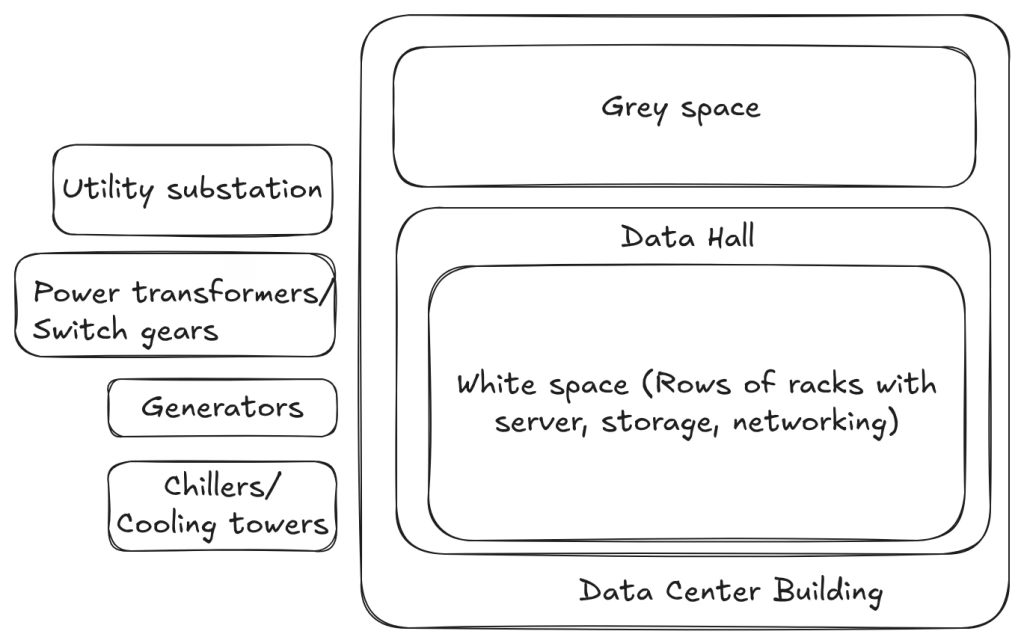
A data center is not just a room full of servers. It is a complex of interconnected systems:
IT Equipment: servers (compute), storage arrays, networking switches and routers. Organized into racks, arranged in rows, grouped into halls.
Power Infrastructure: utility feeds, transformers, switchgear, UPS systems, PDUs (Power Distribution Units), rack-level power strips. Every level has monitoring and redundancy.
Cooling: servers generate enormous heat. Cooling can be air-based (CRACs, CRAH units, hot/cold aisle containment) or liquid-based (direct liquid cooling, immersion cooling). This is one of the largest operating cost categories.
Mechanical, Electrical, Plumbing (MEP): generators, fuel systems, chillers, cooling towers, fire suppression, building management systems. The physical plant that keeps everything alive.
Network: internal switching fabric plus diverse external connectivity to internet exchanges and cloud on-ramps.
The Human Side
Data centers are sophisticated facilities, but they are ultimately operated by people.
Data Center Technicians handle day-to-day operational tasks: deploying and decommissioning servers, replacing failed hardware, managing cabling, executing maintenance procedures. This role requires a mix of IT knowledge and physical skills.
Critical Environment Engineers manage the power and cooling infrastructure, the MEP systems. These are highly specialized roles with deep knowledge of electrical and mechanical systems.
NOC (Network Operations Center) Staff monitor the facility’s systems in real time, responding to alerts and coordinating incident response.
Data Center Managers oversee operations, manage vendors, maintain compliance with certifications (SOC 2, ISO 27001, Tier ratings), and plan capacity.
The persistent challenge in this industry is knowledge transfer. Experienced engineers carry enormous institutional knowledge about how a specific facility works: its quirks, its edge cases, its history. When they leave, that knowledge often goes with them.
This is one of the core problems Visum AI was built to solve.
Why Operations Excellence Matters
The cost of a data center incident scales fast:
- A server that takes 2 hours to fix instead of 30 minutes means 1.5 hours of potential downtime
- A cabling error during a maintenance window can cause an unplanned outage
- A missed inspection can allow a developing fault to become a critical failure
Conversely, operations excellence compounds:
- Faster onboarding means new technicians reach full productivity sooner
- Standardized procedures reduce variation and error rates
- Visual verification catches mistakes before they propagate
As data center density increases (more compute per square foot, higher power draws, more complex cooling requirements), the demands on operations teams increase too. The industry needs tools that multiply the effectiveness of every technician on the floor.
That is the opportunity we are building for at Visum AI.