Rewriting Computer Vision: How Vision-Language Models Are Changing the Game
Traditional computer vision required separate models for every task. Vision-Language Models collapse that complexity into a single, flexible system that understands images and natural language together.
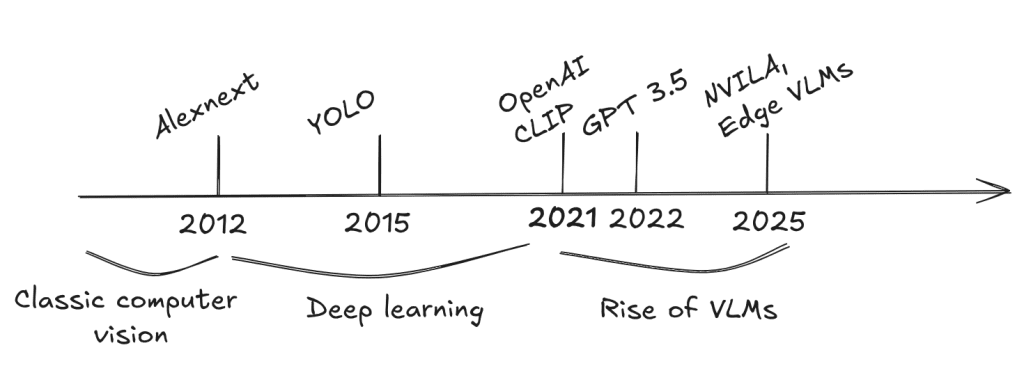
I have spent twenty years building computer vision systems. For most of that time, the answer to every new problem was the same: collect labeled data, train a specialized model, deploy it for a single task.
Want to detect pedestrians? Train a pedestrian detector. Want to read license plates? Train an OCR model. Want to identify server components? Train a classification model on server images.
This paradigm worked. But it was expensive, brittle, and fundamentally unscalable.
Vision-Language Models (VLMs) are changing all of that, and the implications for industrial and infrastructure applications are enormous.
What Makes VLMs Different
A traditional computer vision model is a function: image → label (or bounding box, or segmentation mask). It does one thing, trained on one distribution of data, and it degrades rapidly when the world changes.
A VLM is a function: (image, text) → text. It takes an image and a natural language query, and returns a natural language response. Because it was trained on billions of image-text pairs from the internet, it has a broad prior understanding of the visual world that no single-task model can match.
The key shift is from task-specific perception to general visual reasoning.
Ask a traditional model “is this server correctly cabled?” and it will fail. It was never trained for that. Ask a VLM the same question with an image, and it will reason about cable colors, port labels, documentation in the frame, and spatial relationships to give you a meaningful answer.
Why This Matters for Data Centers
Data centers are full of visual tasks that are too varied, too rare, or too high-stakes to build custom models for:
- “Is this the correct replacement part for slot 4B in rack 12?”
- “What does this warning indicator on the PDU mean?”
- “Is the cable routing in this photo consistent with the SLD?”
For each of these, a traditional CV approach would require a separate labeled dataset and training run. With a VLM, they are all just queries.
But there is a catch.
The Specialization Gap
General-purpose VLMs are trained on internet data. Internet data does not look like a data center.
The visual language of infrastructure (rack unit labels, cable management aesthetics, equipment nomenclature, SLD symbology) is not well-represented in the training data of GPT-4V, Gemini, or Claude. When you ask a frontier model to identify a specific server model from a photo, or to verify a cabling pattern against a reference diagram, the results are inconsistent.
This is why domain adaptation matters. At Visum AI, we fine-tune compressed VLMs specifically on data center imagery, procedural documentation, and equipment catalogs. The result is a model that combines the flexible reasoning of a general VLM with the accuracy of a domain expert.
The Architecture We Use
Our production system has three components:
- A compressed VLM backbone: fine-tuned for data center tasks and quantized for edge deployment
- A retrieval layer: grounds the model’s answers in specific SOPs, equipment manuals, and SLDs for the current facility
- A verification module: checks task completion by comparing the current state against a reference image
Together, these give us a system that can answer arbitrary visual questions about a data center environment, guide step-by-step execution of procedures, and confirm that work was done correctly, all in real time, on-device.
Looking Forward
VLMs are not the final form of computer vision. But they represent a phase transition in what is possible: from narrow, brittle, single-task models to flexible, compositional visual reasoning.
For infrastructure operations (data centers, utilities, manufacturing), this shift is particularly significant. The environments are complex, the tasks are varied, and the cost of errors is high. VLMs, properly adapted and deployed, can change the economics of expertise in these environments entirely.
We are just getting started. The next generation of models will be faster, more grounded, and more capable of reasoning about dynamic physical environments. The question is not whether AI will transform data center operations. The question is how quickly.