Bringing Vision-Language Intelligence to Edge Devices
How Visum AI compresses state-of-the-art Vision-Language Models to run entirely on edge hardware, eliminating cloud latency and privacy risks for mission-critical data center operations.
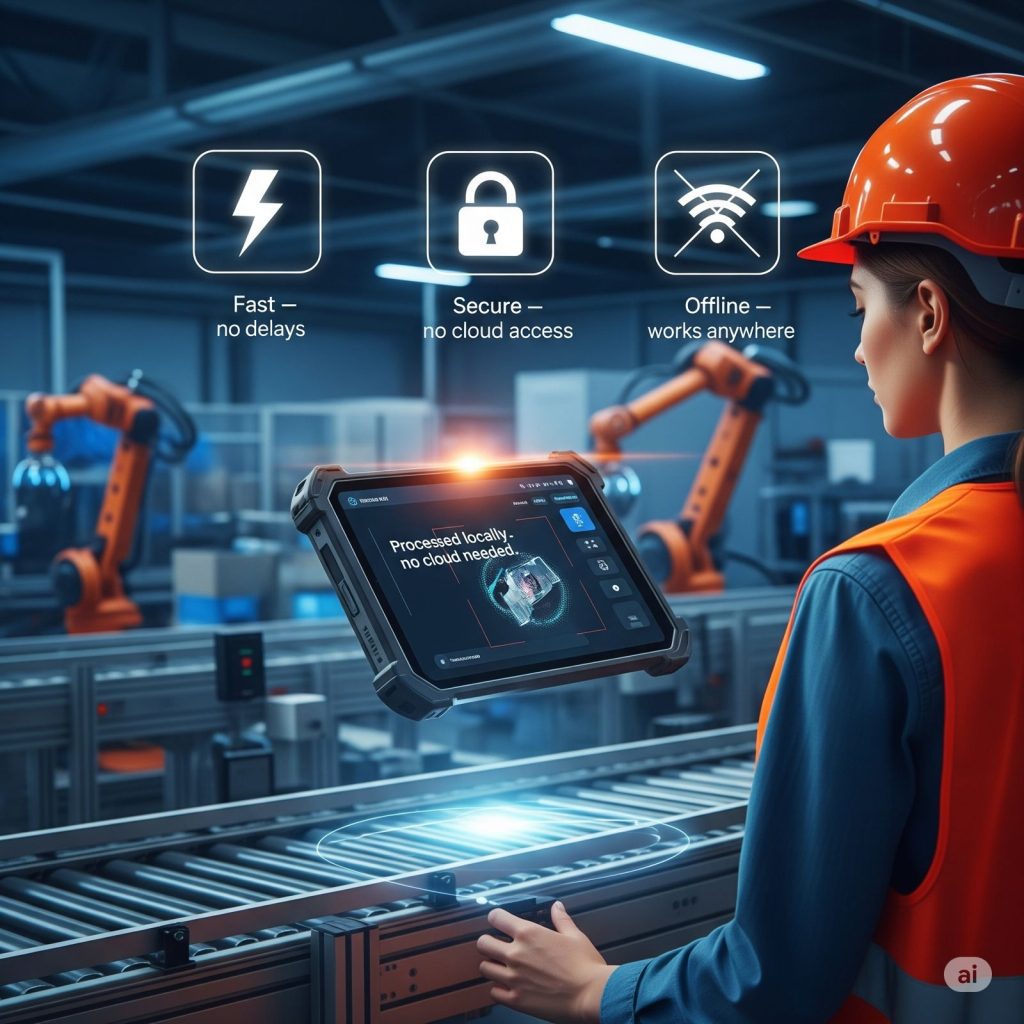
Running a Vision-Language Model on a device that fits in a technician’s pocket was considered impractical just two years ago. Today, it is the core of what Visum AI does. Understanding how we got here is worth explaining.
The Problem with Cloud-Based AI in Data Centers
Most AI-powered tools for enterprise operations assume a reliable, high-bandwidth connection to a cloud backend. For many environments, that is fine. For data centers, it creates three serious problems:
Latency. A technician waiting 2 to 3 seconds for visual guidance on a live task is not getting real-time help. They are getting delayed confirmation of something they have already done.
Privacy. Data center operators handle some of the most sensitive infrastructure in existence. Sending images of server rooms, cable configurations, and equipment layouts to external cloud endpoints is a non-starter for many customers.
Reliability. Edge networks inside large facilities can be isolated, segmented, or deliberately air-gapped. A guidance system that requires internet connectivity is useless in exactly the environments that need it most.
How We Run VLMs on Edge Devices
Our approach combines three techniques that, together, make it possible to deploy a capable Vision-Language Model on consumer-grade edge hardware:
1. Model Compression via Quantization and Pruning
We start with a state-of-the-art open-source VLM and apply aggressive quantization, reducing the precision of weights from 32-bit or 16-bit floating point to 4-bit integers. This reduces model size by 4 to 8x with minimal accuracy degradation on our target tasks (equipment identification, procedural guidance, work verification).
We also apply structured pruning to remove attention heads and MLP layers that contribute little to our specific use cases. The result is a model that retains >95% of the full model’s accuracy on data center tasks while running 6 to 10x faster.
2. Task-Specific Fine-Tuning
Generic VLMs are trained on internet-scale data. Data centers are a narrow, specialized domain. We fine-tune our compressed models on curated datasets of:
- Data center equipment images (servers, switches, PDUs, UPS systems)
- Annotated procedural steps from SOPs and MOPs
- Before/after verification pairs for common tasks
This domain adaptation means our edge model dramatically outperforms a generic model, even a much larger one running in the cloud, on the tasks that matter to our customers.
3. Hardware-Aware Inference Optimization
Modern edge devices (NVIDIA Jetson, Apple M-series, Qualcomm Snapdragon) have dedicated neural processing units (NPUs) that are dramatically underutilized by standard inference runtimes.
We use hardware-specific kernels and memory layout optimizations to push our model’s inference directly onto the NPU, achieving sub-200ms response times for visual Q&A queries on a device that costs under $500.
The Result
A technician holding a tablet or wearing a smart glasses device can:
- Point at a server and ask, “What DIMM slots are available?”
- Get a response in under 200ms, with the relevant slots highlighted in the live view
- Complete a verification step with instant AI confirmation
- Do all of this without a single packet leaving the building
This is what we mean by physical intelligence for data centers. Not a chatbot you access via browser. Not a cloud API call that returns a JSON blob. A real-time visual assistant that understands the physical world and responds at human speed.
Looking Ahead
We are pushing toward sub-100ms response times and exploring deployment on even smaller form factors, specifically smart glasses and headsets that free technicians’ hands entirely.
If you are interested in the technical details or want to discuss deployment for your environment, reach out.