Get technicians ready to work safely on new data center equipment, sooner.

Technicians ready in days, not weeks. Procedures in under 1 hour each. A failed test settled the same day.

Experienced engineers and technicians are scarce, and liquid cooling equipment arrives faster than teams can learn it. Your technicians practice on the exact unit before they touch it, your tests get acceptance limits computed for your site, and every step is checked before anyone carries it out.

Parts of this work were presented at OCP Global Summit 2026 with Lawrence Berkeley National Laboratory.

What changes for your team
ResultTodayWith Visum
Technician ready on a new unitweeksdays
Engineer time per procedure or scriptdaysunder 1 hour
A failed commissioning test1 to 2 weekssame day
Engineer hours saved, site of about 720 proceduresabout 2,800
A coolant distribution unit, modelled from its manufacturer's manuals. The commissioning test runs to the last step, then an unsafe step is refused.

What operators, equipment makers, commissioning firms and service firms tell us

Too few experienced people

New hires learn on the job. Training takes time that senior staff do not have.

New equipment keeps arriving

A new unit every few months, each slightly different. Often nobody on site has run it before.

Liquid cooling commissioning is new

Engineers with Level 4 and Level 5 test experience are committed to other projects. No published document gives the acceptance limit for a cooling unit failover at your site.

Live work has to be done right

Up to 80% of outages involve human error, majority tied to procedural issues.

Uptime Institute's Global Data Center Survey 2025 found that 46% of operators report difficulties finding qualified candidates, and 37% struggle to retain their staff.

Ready staff, a clear test day, and work done right on live equipment

Each part below links to a short video of the product.

Operator training

Technicians ready on a new unit in days, not weeks

Your technicians practice each task on a 3D model of the exact unit before they touch the real one. They can try the steps in any order. The operator trainer refuses an unsafe step, with the reason and the page of the manufacturer's manual.

  • Every failure practiced before the site visit: a unit loss, a slow valve, a sensor offset
  • Instructors raise alarms during practice and see who has met the standard
  • Every run is logged, and each technician is signed off on what was assessed
Commissioning

Commission a liquid cooled hall with the crew you have

Our software simulates your site's cooling units, sets the acceptance criteria for each test, and on test day tells your crew whether each test passed and, when one fails, why.

  • Acceptance limits computed for your site: the spare cooling unit must start within 60 seconds at full load and within 5 minutes at half load
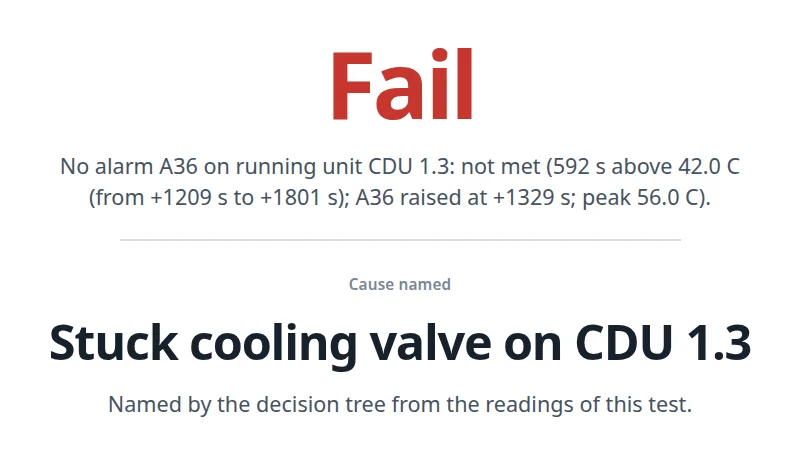
  • A failed test settled the same day: Live Commissioning names the cause and the next test
  • A signed test record for the owner, with every reading, time and verdict
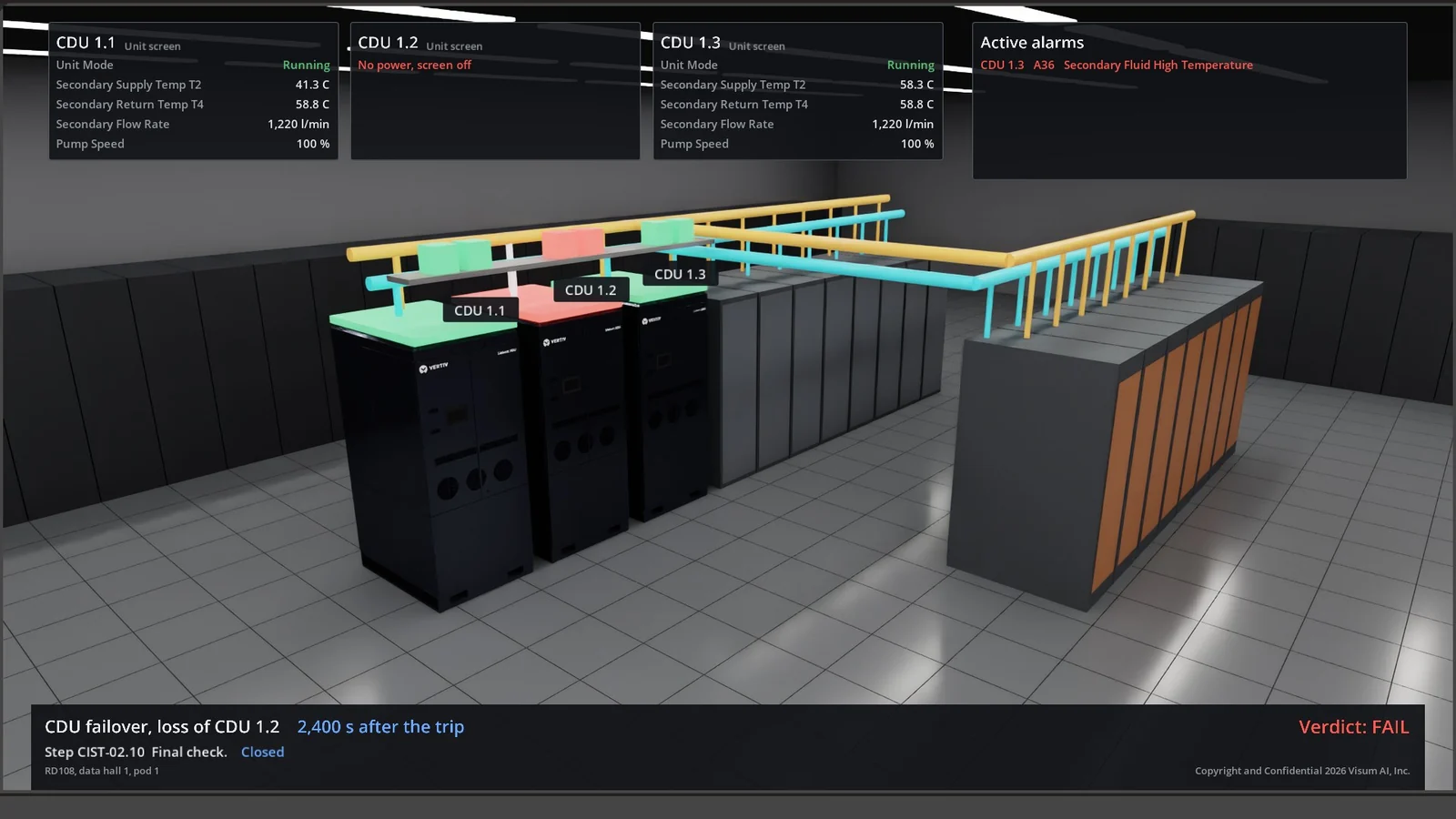
Three cooling units and their racks in 3D during a failover test. One unit is off, one shows a high temperature alarm, and the verdict reads Fail. Live Commissioning on a tablet: the verdict Fail with the reading that caused it, and the cause named as a stuck cooling valve on one unit.

Procedures

Procedures in under 1 hour each, checked before anyone carries them out

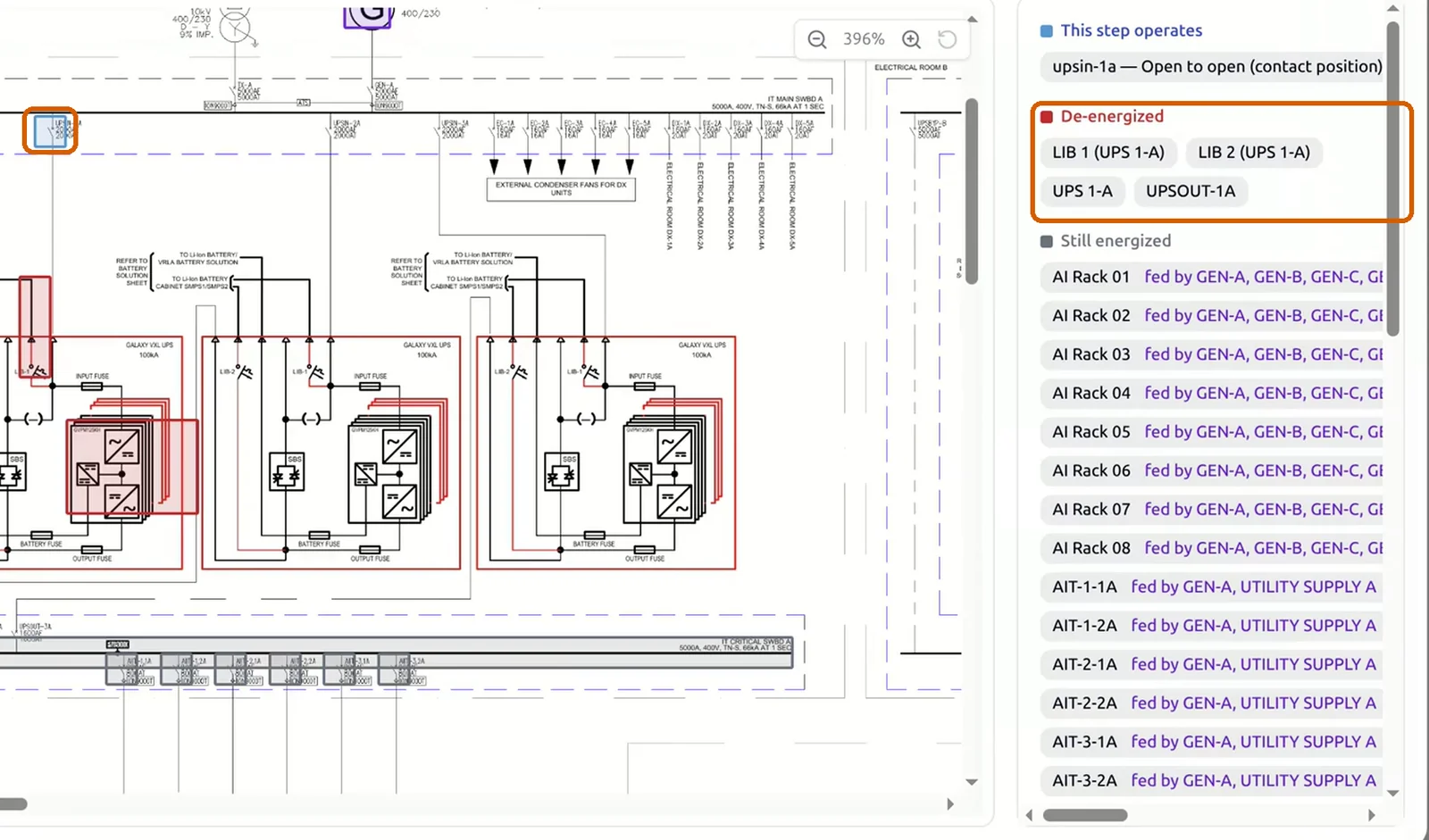
Our software writes the first draft of each MOP (method of procedure), SOP (standard operating procedure) and EOP (emergency operating procedure) for the unit installed. Your engineers review, correct and sign off. Before a step runs, the procedure shows what loses power or flow and what stays on.

  • Days reduced to under 1 hour per procedure
  • If a second feed still reaches the equipment after isolation, it is named
  • A site of about 720 procedures: about 2,800 engineer hours and $267,000 to $380,000 of engineer time saved
A site electrical drawing next to a procedure step. The breaker the step opens is outlined, with the equipment that loses power and the racks that stay on.

In the field

Every step checked as the technician carries it out

The Execution Assistant guides a technician through each step on a phone or tablet. It checks each step against the equipment's live readings and stops the work at hold points until the named person approves. A newer technician safely carries out work that today depends on years of site experience.

  • Each step closes on a live reading from the equipment
  • A valve left closed or a leak keeps the step open
  • The loop owner signs the record
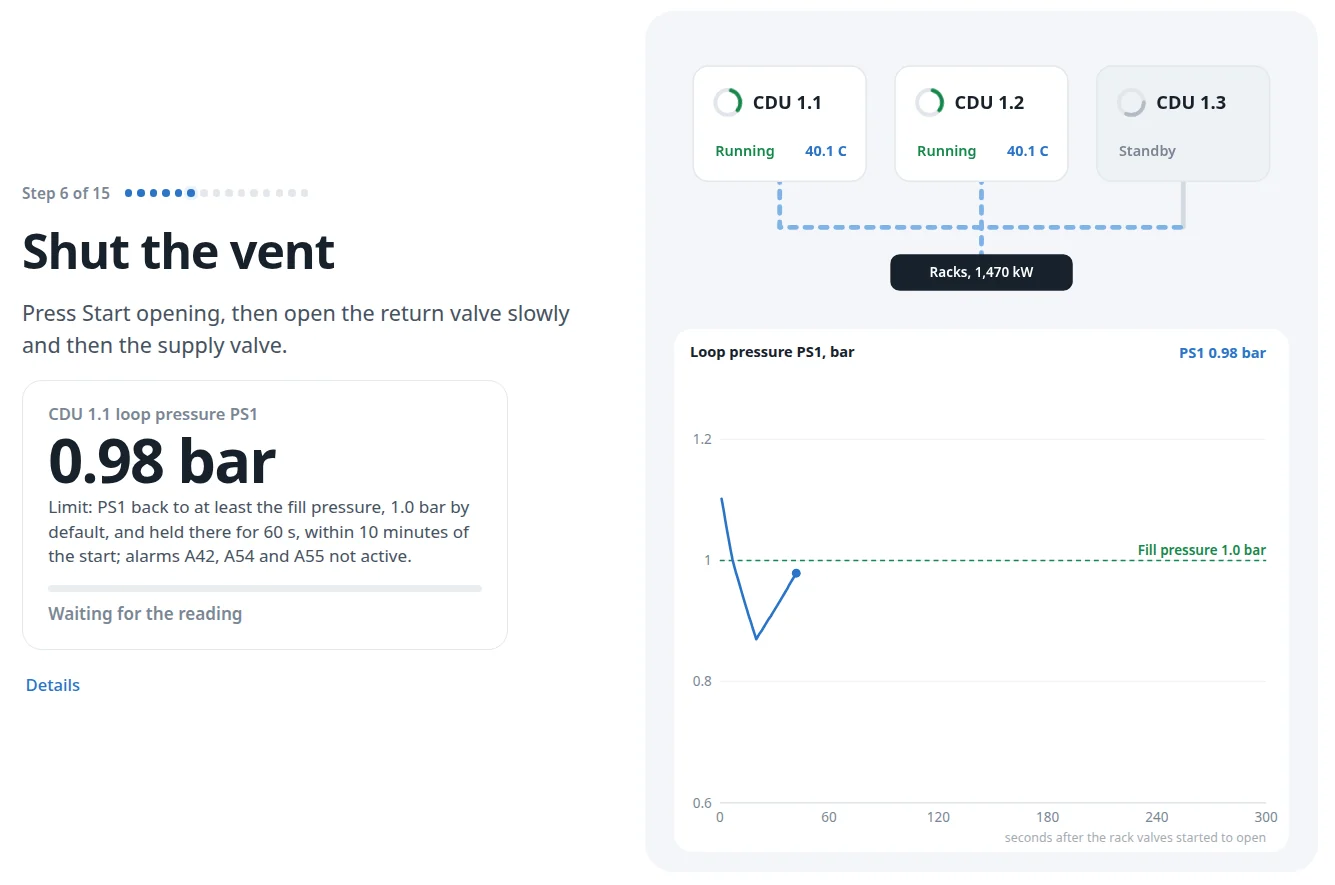
A tablet step for adding a rack to a running coolant loop. Loop pressure reads 0.98 bar against a 1.0 bar limit, so the step stays open.

Adding a rack to a running coolant loop: the step stays open until loop pressure is back above its limit.

Faster commissioning. Faster revenue. Safer operations. Ready staff.

Time

under 1 hour

Per procedure, down from days. A full site library in weeks. Senior engineers review and sign off.

Revenue

same day

A failed test is settled the same day. Commissioning starts the day the site is built. Earlier handover, faster time to revenue.

Risk

up to 80%

Of outages involve human error, majority tied to procedural issues. Every step is checked before anyone carries it out.

Staff

days, not weeks

Technicians ready on a new unit. You know who is signed off on which unit.

Every team on the project is ready sooner

Commissioning firms and start up crews

Take on liquid cooled halls with the crew you have. Your crew rehearses each test, works to acceptance criteria computed for the site, settles a failed test the same day, and leaves with a signed test record.

Operators, AI cloud operators and colocation providers

Site staff ready before handover, in days, not weeks. Every commissioning script checked step by step, including the ones your contractor wrote. Fewer failed tests and fewer outages from a wrong step on live equipment.

Operations, maintenance and field service firms

New technicians ready for your customer's exact units in days, not weeks, with a record of who is signed off on which equipment.

Equipment makers (CDU, UPS, switchgear)

Your field staff and your customers trained on each new unit before it ships. Every unit arrives with its commissioning scripts, acceptance criteria and procedures.

Engineering firms

Deliver the operating procedures, commissioning scripts and staff training with your engineering package. The owner starts commissioning the day the site is built.

Presented at OCP Global Summit 2026 with Lawrence Berkeley National Laboratory

Two sessions at OCP Global Summit 2026

"Machine-Verifiable CDU Safety Procedures", Cooling Environments track, and "From Guided Technicians to Lights-Out AI Factories", Future Technologies Symposium. The talks

Siemens

Technology development partnership.

A real data center engagement

800 or more procedures, 718 of them from one real data center engagement.

Simulation at site scale

48,384 unit loss cases simulated in 8 seconds on one GPU.

Backed by NVIDIA Inception Program member Google for Startups

Fixed rules decide every result, not an LLM

No LLM decides pass or fail

Fixed rules check each step against a model of your equipment and your site. The same documents give the same result every time.

An unsafe step is refused, with the page

If a step is tried out of order, our software refuses it and names the manual page that makes the order unsafe.

Your engineer stays the author

Every value is cited to your documents. Your engineer reviews, corrects and signs off.

It takes the documents you already have

  1. You send the manufacturer's manuals and your site drawings.
  2. Visum builds a model of each piece of equipment and of how your site connects it.
  3. Our software checks every step against those models.
  4. Your engineers review and approve.

Try it free on one piece of your equipment

Send the manufacturer's manuals for one unit. You get its training, its commissioning tests with acceptance criteria for your site, and its procedures.

We also want to hear what slows your team down.